October 23, 2026
The AI transformation roadmap starts with seeing the work first
Most AI transformation roadmaps stall because they're built on assumptions. Here's how a discovery-first approach helps you prioritize, sequence, and measure what actually drives ROI.

Most AI transformation roadmaps aren't built on evidence of what actually drives ROI (return on investment). They're built on assumptions: whichever pain point is loudest or most recent, a leadership hunch about what "AI-ready" work looks like, or an AI strategy shaped around business goals without enough visibility into the work behind them. The roadmap gets a name, a slide deck, and a sequence of AI implementation initiatives, and it stalls anyway. The problem is that it was never built on an accurate picture of how work actually happens.
An AI transformation roadmap can be well-structured, well-resourced, and still fail if it prioritizes automations that don't actually move the needle. Fixing that starts before any planning document gets written, with visibility into the work itself.
Why most AI transformation roadmaps stall before they start
The usual explanation for a stalled AI initiative is "poor planning." The more specific and more accurate explanation is that most roadmaps get built from guesswork rather than evidence.
Priorities tend to come from:
- The loudest internal voice: a team or executive pushes a particular use case to the top of the AI transformation roadmap.
- The most visible pain point: a recent or acute problem becomes a priority without being tested against the wider operating model.
- A leadership hunch: there's a general sense that "AI should help with X," but nobody has established how X actually gets done.
- A promising AI pilot: a successful proof of concept earns a place on the roadmap before anyone establishes whether scaling it will meaningfully support wider business goals.
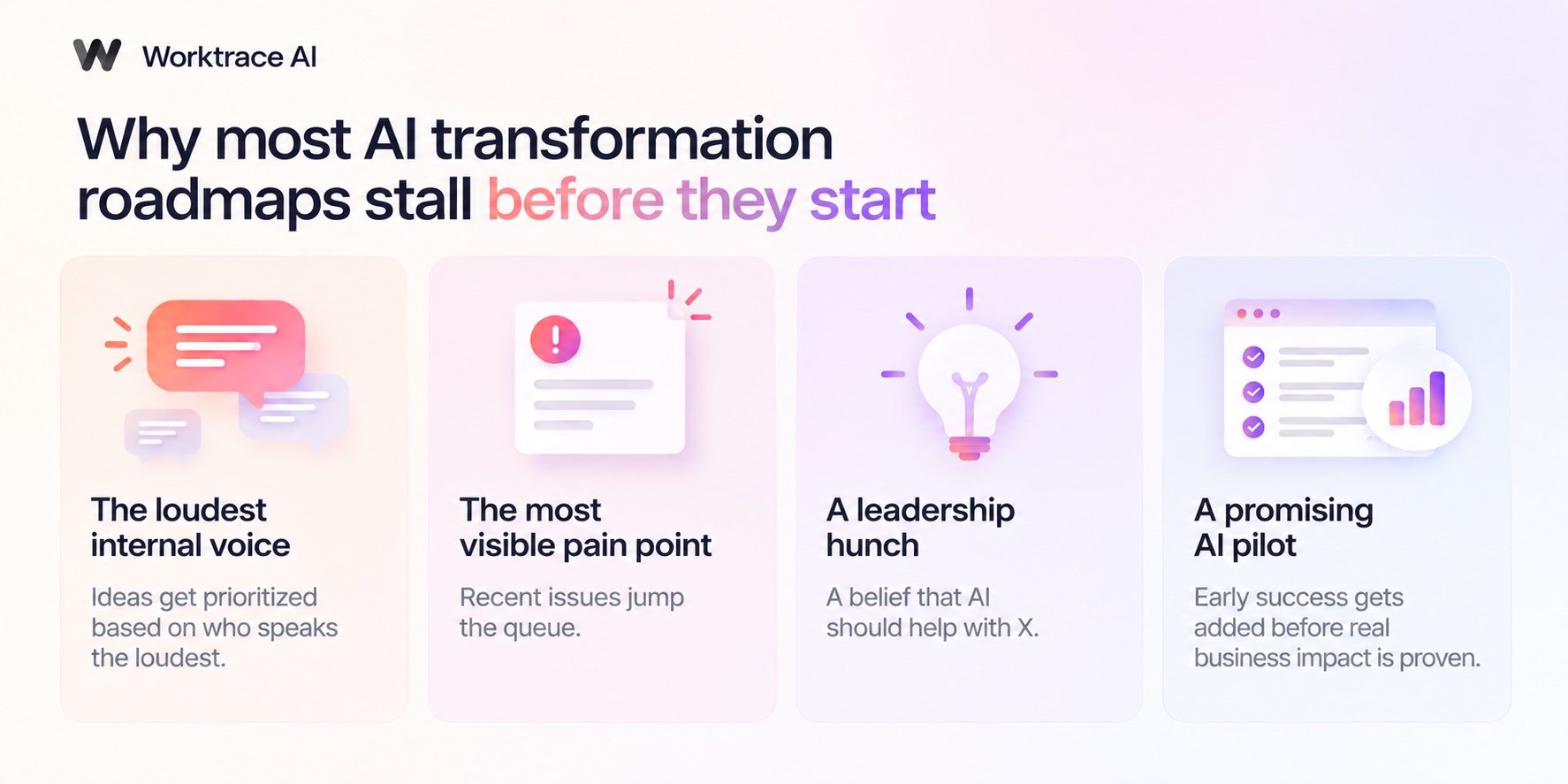
None of those are necessarily bad ideas. The problem is that they're being used as evidence of where AI will create the most value when they don't actually tell you that.
That's a costly pattern, and not just because the wrong project gets funded. Gartner reports that only 28% of AI use cases in infrastructure and operations fully succeed and meet ROI expectations, and that many of the 57% of leaders who reported a failure said it was because they expected too much, too fast.
A visible miss can also damage confidence in what comes next. Fatigue sets in fast, and the next genuinely good idea may not get a fair shot. Early prioritization therefore affects more than the ROI of a single project. It can build or undermine confidence in the wider AI transformation.
This is a version of the same gap covered in why global business services functions struggle to show AI value: you can't reliably prioritize, sequence, or defend a roadmap built on work you can't actually see.
Start with visibility, not jumping into building
The instinct once an AI mandate lands is to start building: pick a use case, stand up a pilot, show progress. Building first means committing engineering time and executive credibility to an assumption before confirming where the value actually is.
That pilot-first approach is common, but scaling it is proving much harder. BCG found that 64% of CEOs say their companies pursue AI pilots, while only 26% have embedded AI as part of a broader business transformation.
Before deciding what belongs on your AI transformation roadmap, establish:
- What work is actually happening: Map workflows as they're performed today, including manual handoffs, workarounds, variations, and the decisions that never made it into process documentation.
- Where time and effort are going: Identify the repetitive tasks, bottlenecks, delays, and high-volume work creating measurable operational cost.
- Where AI could realistically improve the workflow: Separate opportunities for automation, generative AI, or AI agents from work that still requires human judgment or intervention.
- What the baseline looks like: Establish the performance metrics you'll need to judge whether an AI implementation actually improves the process, rather than trying to reconstruct them after deployment.
- How each opportunity connects to business objectives: A technically viable use case doesn't automatically belong on the roadmap. Tie potential initiatives to outcomes such as cost reduction, capacity, service improvement, or revenue growth.
Think of this as the discovery layer of an AI readiness assessment: not simply asking whether the organization has the technology, data, governance, and skills to adopt AI, but establishing where AI adoption can create measurable value in the first place.
Seeing the work first turns "we think this is worth automating" into "we know this is worth automating, and here's why." It also gives executive sponsors and business leaders evidence they can interrogate before resources are committed to AI pilots or technology deployment.
What a discovery-first AI transformation roadmap looks like
A roadmap grounded in observed reality generally moves through four stages. Each one should narrow the field: from understanding all the work being done, to identifying where AI fits, deciding what deserves investment, and sequencing AI implementation around measurable business value.
1. Map how work actually happens
Start by establishing an accurate baseline: what a process actually is today, not what an org chart or a wiki page says it should be. Capture how it's performed across the team, including workflow variations rather than a single idealized process.
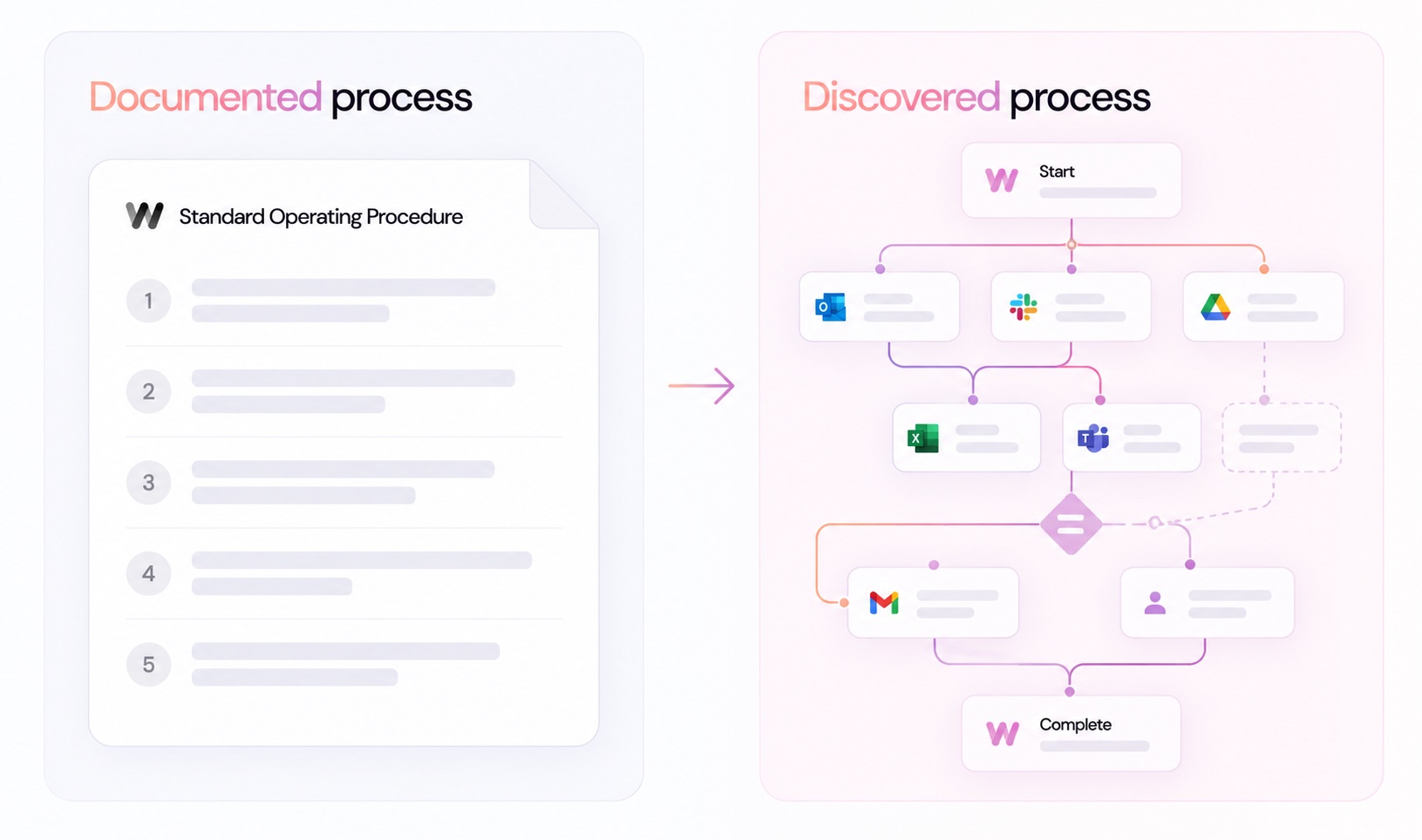
Look beyond individual tasks to understand the wider operating model: where work starts and ends, which teams and AI platforms or other systems it crosses, where manual handoffs occur, what data it depends on, and where people make decisions or create workarounds. This gives you the baseline against which future AI implementation can be measured.
2. Identify automation- and AI-ready workflows
With a real baseline in hand, the next step is separating tasks that are genuinely repetitive and rules-based from ones that depend on judgment calls that shouldn't be automated away, at least not without careful human oversight.
Then assess what type of intervention actually fits. Some work may suit traditional automation, some generative AI or AI agents, and some may be a candidate for more agentic AI that can reason across multiple steps. Other problems may not need AI at all.
This is where a lot of self-identified automation ideas fall apart: teams often propose the automation they can picture most easily, not the highest-value opportunity across the full workflow.
At this stage, also surface dependencies that could affect AI readiness, such as data quality, data governance, human oversight, or access to the systems an AI solution would need to use.
3. Prioritize by impact and feasibility
Not every automatable workflow is worth building first. Prioritization has to weigh both how much value an automation would return, including time saved, error reduction, and cost avoided, and how feasible it actually is to build and maintain given the tools, data, and internal expertise available.
Score opportunities against consistent criteria, including expected business impact, implementation complexity, data readiness, governance requirements, risk, and strategic alignment with wider business objectives. Define the success metrics or KPIs that would demonstrate value before a project enters development.
A high-value workflow that's hard to automate well may need to wait behind a lower-value one that's fast and low-risk to ship, especially when you need an early, visible win to keep momentum.
There's evidence that greater focus produces better results. BCG found that leading companies prioritize an average of 3.5 AI use cases, compared with 6.1 among other companies, and expect 2.1 times greater ROI from their AI initiatives.
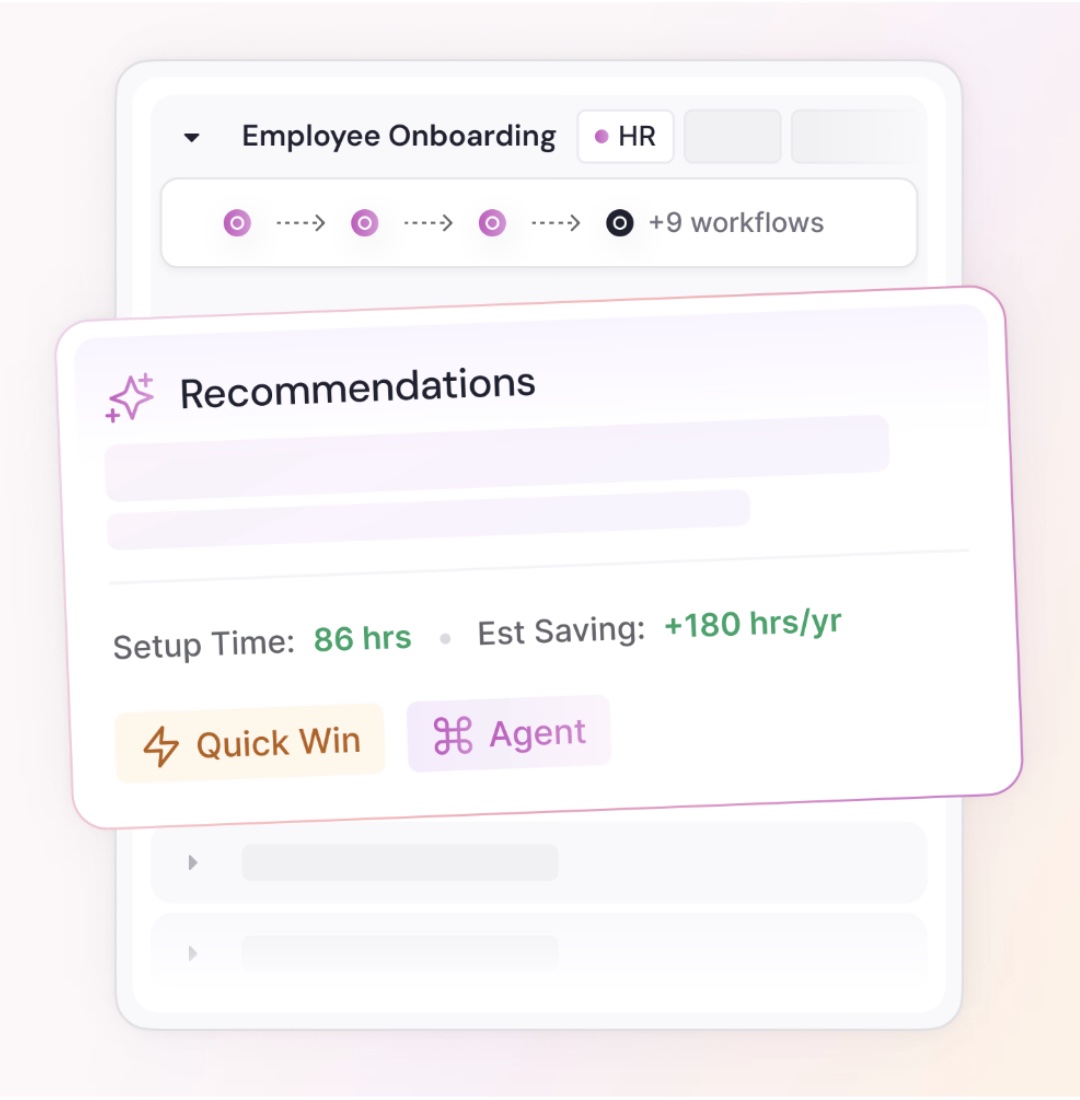
The output isn't simply a ranked list of AI use cases. It's an evidence-based portfolio showing what to pursue now, what needs further preparation, and what isn't worth building.
4. Sequence rollout and measure ROI from deployed automations
Roll out in an order that builds credibility, not just the order that maximizes theoretical value. Early wins, even modest ones, buy the trust needed to tackle harder, higher-stakes automations later.
Turn the prioritized portfolio into an AI implementation roadmap: which initiatives move into pilot projects first, what dependencies need to be resolved, who owns each initiative, and what needs to happen before it can scale. Factor in governance, change management, and upskilling alongside technology deployment rather than treating them as separate workstreams that happen later.
Once something is deployed, measure it against the baseline you established in step one, using the metrics that mattered at the outset (time saved, error rate, cost per transaction), rather than declaring success anecdotally.
Then use those results to update the roadmap. Successful pilots can move toward wider deployment, weak ones can be reworked or stopped, and new opportunities can be reprioritized as the organization's AI maturity increases.
How Worktrace AI fits into your roadmap
Worktrace AI is built to sit at the front of this process, at the point where most roadmaps currently rely on guesswork. A lightweight desktop app observes how a team actually works across every application it touches, in a focused, two-week discovery snapshot, with zero system integrations required. Observation stays at the team level: Worktrace doesn't track individual productivity or keystrokes, redacts PII on-device and in the cloud, and runs on an allowlist/denylist basis with opt-in consent.
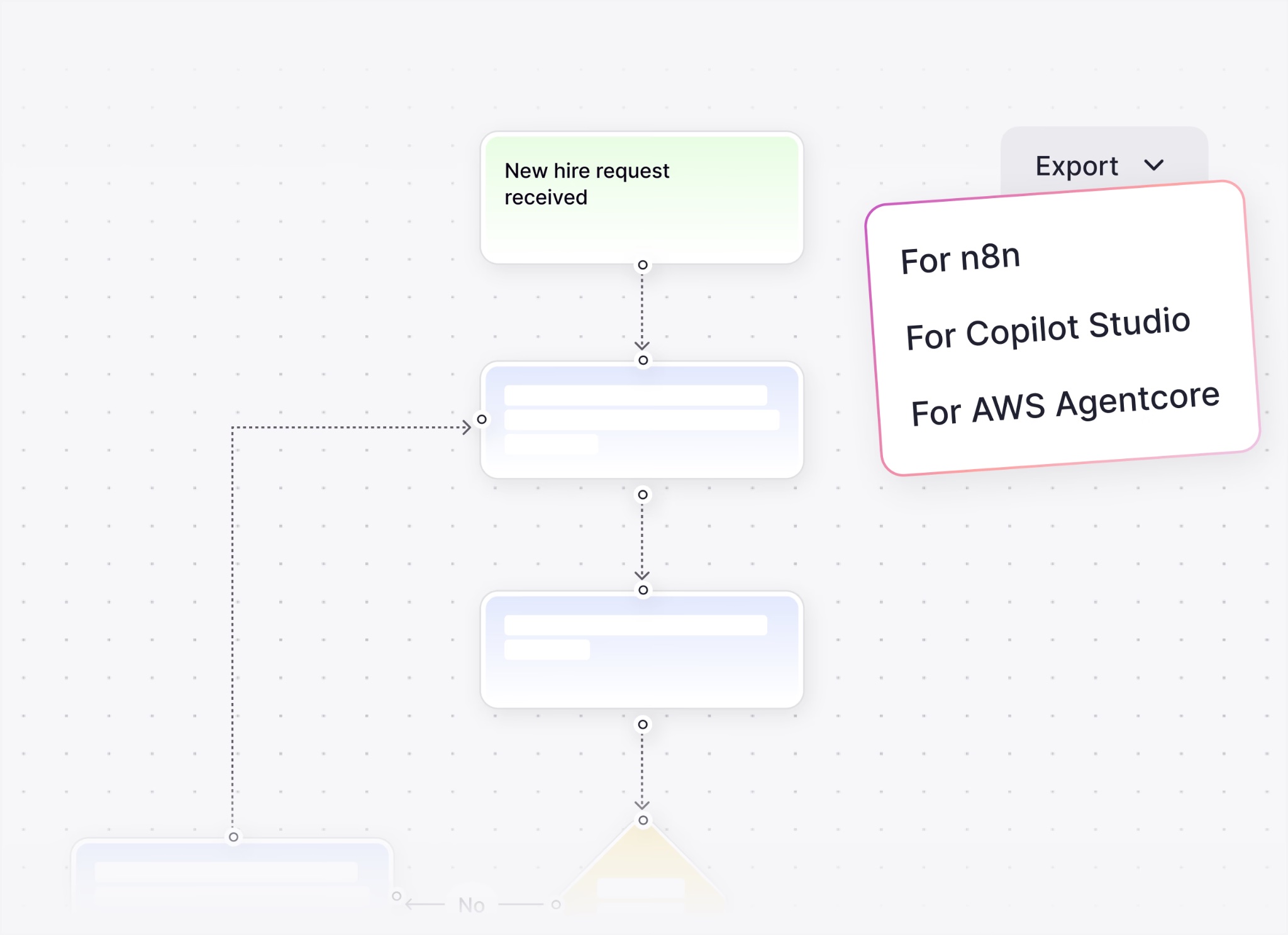
That mapping is paired with semantic understanding: Worktrace's AI reasons about what's on screen and why an action was taken, not just that a click occurred. It then turns that understanding into structured workflows, standard operating procedures (SOPs), prioritized opportunities, and build-ready automation and AI agent blueprints. That gives AI transformation leaders evidence for deciding what belongs on the roadmap and a clearer starting point for AI implementation once those priorities are set.
Delhivery, India's largest integrated third-party logistics provider, used this approach to establish a baseline across roughly 20 teams, including security, supply chain, and operations, without integrating into their internal systems first. Within weeks, that visibility surfaced 8 high-priority automation blueprints, along with process gaps that could be resolved without automation at all, giving their team an evidence-based starting point for sequencing rather than a guess.
That discovery layer can sit underneath a wider AI strategy or AI transformation roadmap, helping leaders move from “where could we use AI?” to a prioritized view of what to change, what to automate, and what to build first. For more on that shift, see the case for AI transformation leaders owning discovery, not just automation and how automation has evolved from RPA to agentic discovery. Worktrace AI's use cases page shows what this looks like across specific functions like finance, IT, HR, and customer support.
Build your AI transformation roadmap on evidence
A roadmap is only as good as the picture of reality it's built on. Before choosing AI pilots, platforms, or implementation priorities, establish where the work is actually happening, where the biggest opportunities are, and what measurable value changing it could create. That evidence gives you a stronger foundation for deciding what to prioritize, build, and sequence, and for adapting the roadmap as your AI transformation progresses.
Build an AI transformation roadmap based on how work actually happens, not assumptions. Request a Worktrace AI demo and start with a 2-week discovery snapshot before you commit to a single automation or AI tool.
FAQs about AI transformation roadmaps
How do you avoid prioritizing the wrong automations first?
To avoid prioritizing the wrong automations, start with an observed baseline of how work actually happens. Map the full workflow, including variants, before prioritizing opportunities based on expected ROI, feasibility, and alignment with business goals.
Do we need to integrate our systems before starting?
You don't necessarily need to integrate your systems before starting. Some discovery methods, like process mining, require system integrations. Worktrace AI observes work across the applications employees already use, so it can map workflows without integrating with individual systems first.
How do you estimate the ROI from automation initiatives?
To estimate ROI from automation initiatives, establish a baseline for time spent, volume, error rates, and cost before implementation. Then compare those metrics against post-deployment performance and the cost of building and running the automation.
Read more

October 26, 2026
Process discovery methods compared
Interviews, observation, process mining, task mining, or screen-level observation? Compare five process discovery methods and see which one fits the decision in front of you.


Agents you'll actually use
Worktrace discovery maps exactly how your team works and finds the most repetitive work. Then it builds Al agents that do that work.
We'll get in touch with you shortly.





of enterprise work is automatable