November 12, 2026
How PII redaction works in AI automation
How PII redaction protects sensitive data in AI automation, from detection techniques to where redaction fits in the pipeline, and how Worktrace masks data before analysis.

Getting AI automation right starts with understanding how work actually happens. You need to see how people complete tasks, where they move between tools, and what information they use along the way. But real work involves real data, including personally identifiable information (PII) and other sensitive data that you don't want passing into an AI model.
PII redaction solves that problem by detecting and removing sensitive information before the activity is analyzed. The useful details about how work happens stay intact, while the personal data within it is removed before AI processing begins.
For Ops Leaders exploring AI automation, understanding how that redaction works, what it catches, and where it happens is key to evaluating whether a platform can safely analyze real work.
What is PII redaction?
PII redaction removes personally identifiable information (PII), or replaces it with a non-sensitive placeholder, so the original value can't be seen or used in the data that remains. This can include names, email addresses, phone numbers, government ID numbers, and account details. In AI automation, PII is detected and redacted before the data is stored, analyzed, or passed to an AI model.
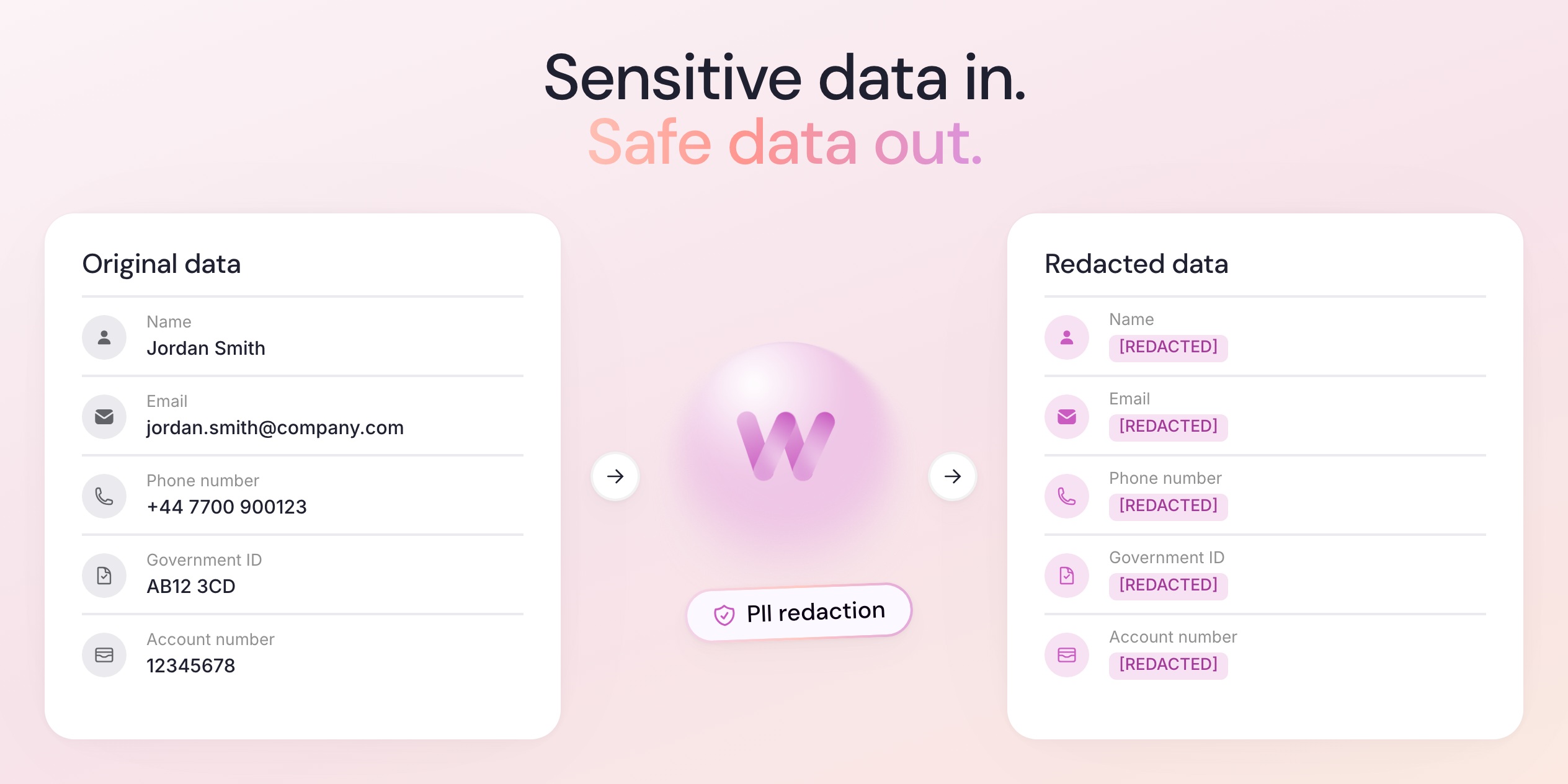
It's distinct from simply restricting who can view a document. Redaction changes the data itself, so the sensitive value is gone or replaced with a placeholder by the time it reaches the next step.
PII redaction is increasingly necessary as AI automation reaches workflows containing customer, employee, financial, and other sensitive data. Without it, personally identifiable information can end up in logs, model context, or other downstream systems where it isn't needed.
How PII redaction typically works
Most PII redaction systems combine complementary techniques because no single method catches everything:
- Pattern matching (regex): Structured values like credit card numbers, Social Security numbers (SSNs), phone numbers, IP addresses, and email addresses follow recognizable formats, so pattern-based rules can detect and mask them quickly and reliably. This is usually the first line of defense.
- Optical character recognition (OCR): Sensitive data doesn't only appear as typed text. Screenshots, scanned forms, and PDFs first need to be converted into machine-readable text so PII detection can run against them.
- Natural language processing (NLP): Names, addresses, and other identifiers in free-form text, such as an email, support ticket, or transcript, don't follow a fixed pattern. NLP techniques such as named entity recognition (NER) can identify these values based on their context. For example, is "Jordan" a person's name or a place name in this sentence?
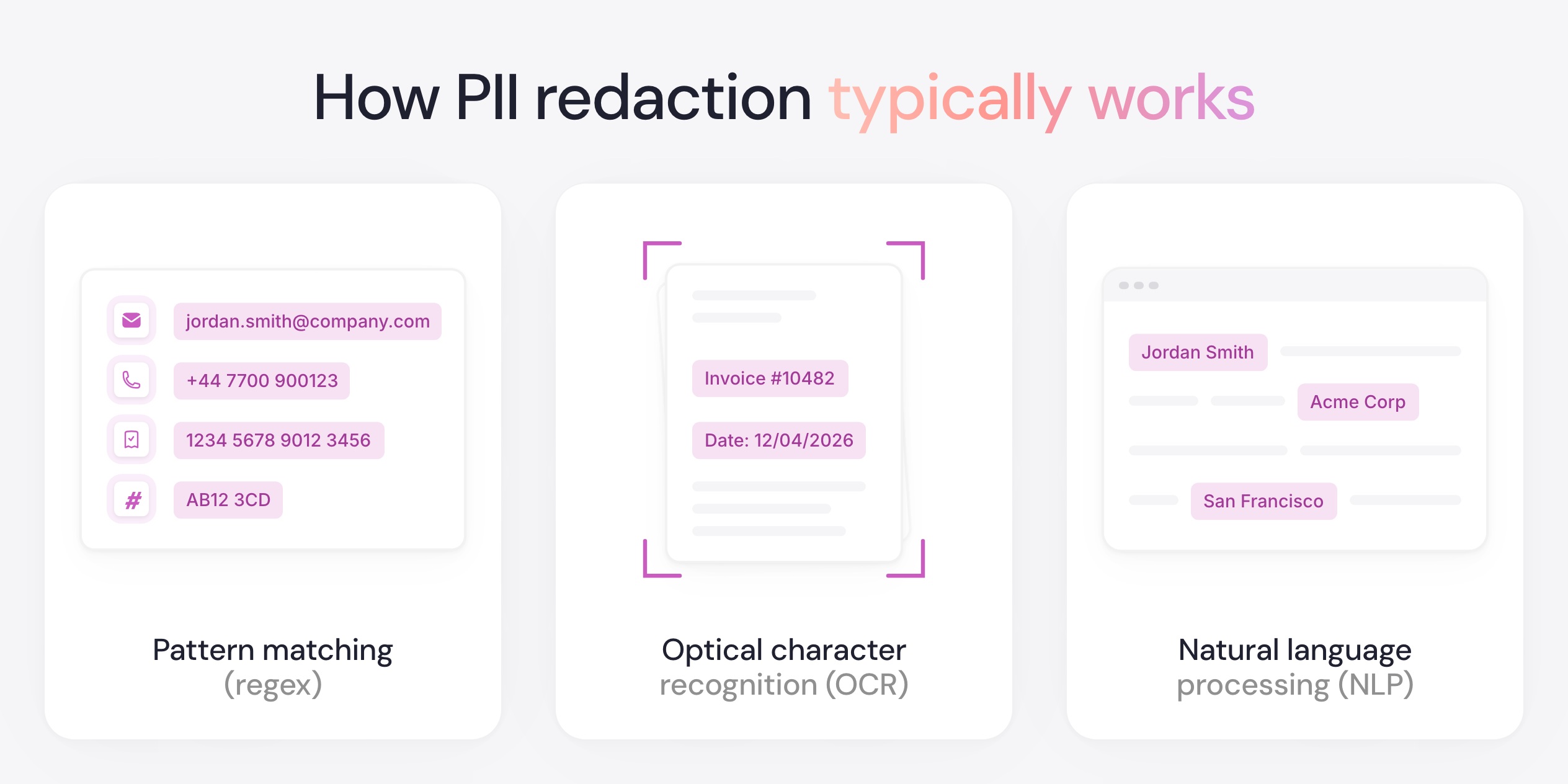
Pattern matching works well for structured data, but it can miss PII that depends on context, such as a person's name in a sentence. That's why PII redaction systems typically combine pattern matching with context-aware detection.
The challenge is catching sensitive data without removing useful information. If detection is too narrow, real PII can slip through. If it's too broad, the system can redact information that isn't actually sensitive, such as a product name mistaken for a person's name. Using multiple detection methods helps reduce both kinds of error.
Where PII redaction fits in an AI automation pipeline
PII redaction needs to happen before sensitive data reaches an LLM or any other analysis system. Once unredacted data has been sent to a model, included in a prompt, or captured in a log, redacting it later doesn't undo that exposure. Sensitive information may already have been stored, processed, or made accessible in systems where it wasn't intended to go.
This is a common problem as AI becomes part of everyday work. Cyberhaven's 2026 analysis found sensitive information in 39.7% of interactions with AI tools, showing how easily personal and business data can enter AI workflows without users realizing.
The earlier redaction happens, the less sensitive data travels through the pipeline. Ideally, PII is detected and removed at the source, before the data leaves the device or system where it originated. From that point on, downstream systems can work with the redacted data rather than the raw input.
Why PII risk makes redaction critical for AI automation
Once PII enters an AI system, it can become harder to control where that information goes and how it is used. Sensitive data can move through prompts, logs, models, connected tools, and other parts of the AI pipeline, creating more places where it could be stored or exposed.
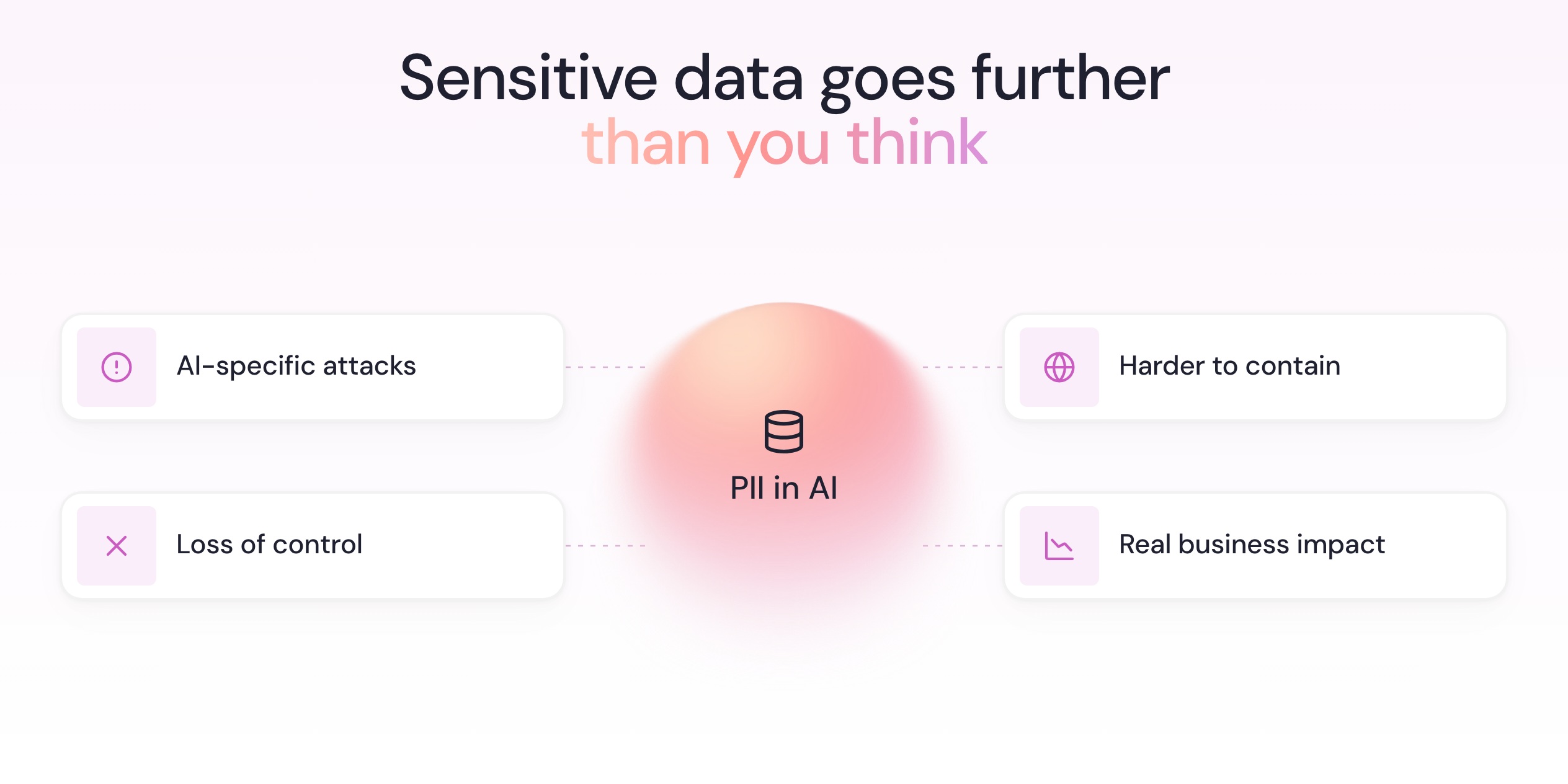
The risks also go beyond a conventional data leak:
- Sensitive data can be exposed through AI-specific attacks: Prompt injection can manipulate an AI system into revealing information or taking unintended actions, while model inversion attempts to reconstruct sensitive information from a model's outputs. That creates new routes to PII beyond directly accessing the system where the data was originally stored. The financial impact can be significant: IBM's 2026 research found that breaches involving model inversion attacks cost organizations an average of $6.07 million, while those involving prompt injection averaged $5.89 million.
- A breach can become much harder to contain: If PII has moved through prompts, logs, models, and connected systems, a security team isn't dealing with one compromised database. It has to work out everywhere that data traveled, whether copies remain, who or what had access to them, and how to remove or secure them. IBM's 2026 Cost of a Data Breach report already puts the average global cost of a breach at $4.99 million. Add the complexity of tracing and containing PII across an AI pipeline, and those costs can quickly become even harder to control.
- Organizations can lose control of how personal data is used: PII collected for one purpose can end up being processed by models or connected tools for another. That can leave an organization unable to clearly answer basic governance questions about where someone's data went, why it was processed, who had access to it, or whether it should still exist there. For regulated data, that can create additional exposure under requirements such as GDPR and HIPAA.
- The damage can have real commercial implications: Responding to exposed PII can mean costly remediation, regulatory scrutiny, and operational disruption. But the financial impact goes beyond breach containment. Customers and employees may lose trust in how the organization handles their information, which can translate into lost customers and revenue. IBM's Cost of a Data Breach research found that lost business accounts for 30.9% of data breach costs.
Redacting PII before AI processing reduces the amount of sensitive information available to be stored, propagated, or exposed if something goes wrong.
What good PII redaction looks like
Effective PII redaction does more than identify obvious personal information. It controls what gets removed, when redaction happens, and how different types of sensitive data are detected.
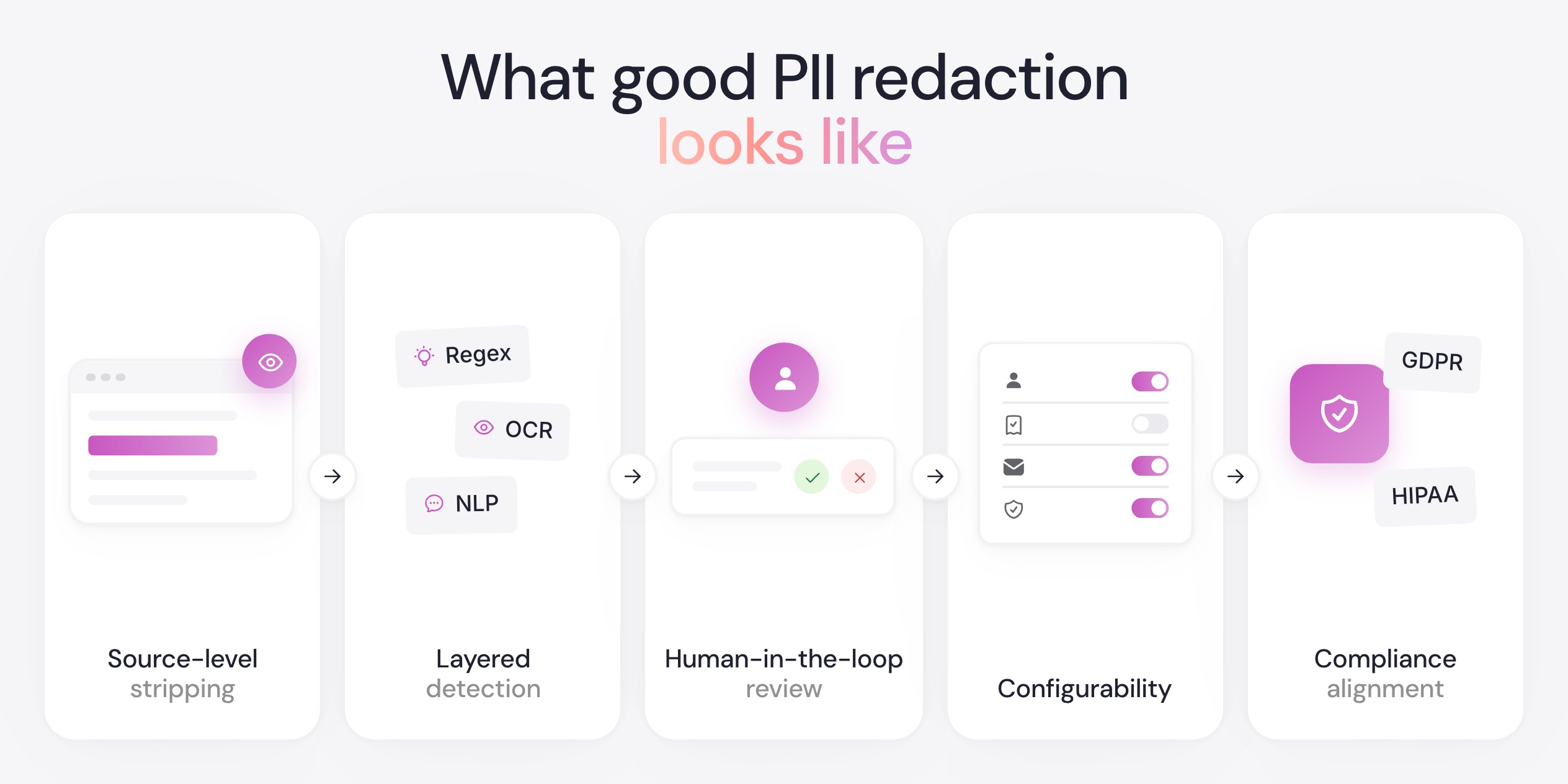
In practice, effective PII redaction has a few characteristics in common:
- Source-level stripping: Identifiers are removed at or near the point of capture, before unredacted data travels further through the pipeline.
- Layered detection: Structured, pattern-based detection is paired with context-aware methods, since names, addresses, and other identifiers in free text won't reliably match a regex pattern.
- Human-in-the-loop review: Automated redaction handles the volume, while human review can be used for low-confidence matches and edge cases where context matters. It also gives teams a way to check how well their redaction rules are working.
- Configurability: What counts as sensitive varies by customer, industry, and even team. For example, financial services workflows can contain account and payment information that requires particularly careful handling. Redaction rules should be configurable so teams can protect the data relevant to their environment without unnecessarily removing useful business context.
- Compliance alignment: PII detection and redaction should reflect the regulations that apply to the data being handled. Different frameworks protect different categories of sensitive information. GDPR covers personal data broadly, while HIPAA applies specific protections to protected health information (PHI). Redaction rules need to account for the requirements that apply to the organization's data and workflows.
How Worktrace handles PII redaction
Worktrace AI is a workflow discovery platform. Its lightweight desktop agent captures how work moves across tools during a scoped two-week snapshot, giving teams the data they need to identify AI automation opportunities.
Because that data can contain personally identifiable information and other sensitive data, Worktrace applies PII redaction before AI analysis begins.
PII is redacted in two layers
The first layer runs locally on the device. The Worktrace desktop agent uses configurable pattern matching (regex) to detect and mask structured sensitive data, including credit card numbers, government IDs, and email addresses, before it leaves the device.
The second layer catches PII that requires more context to identify. Before AI processing begins, Worktrace runs a configurable, context-aware redaction pass for each customer in the cloud. This layer is built to catch identifiers that pattern matching alone would miss, such as person names and other context-dependent identifiers, including health identifiers in clinical or patient workflows, embedded in free-form text rather than a fixed pattern.
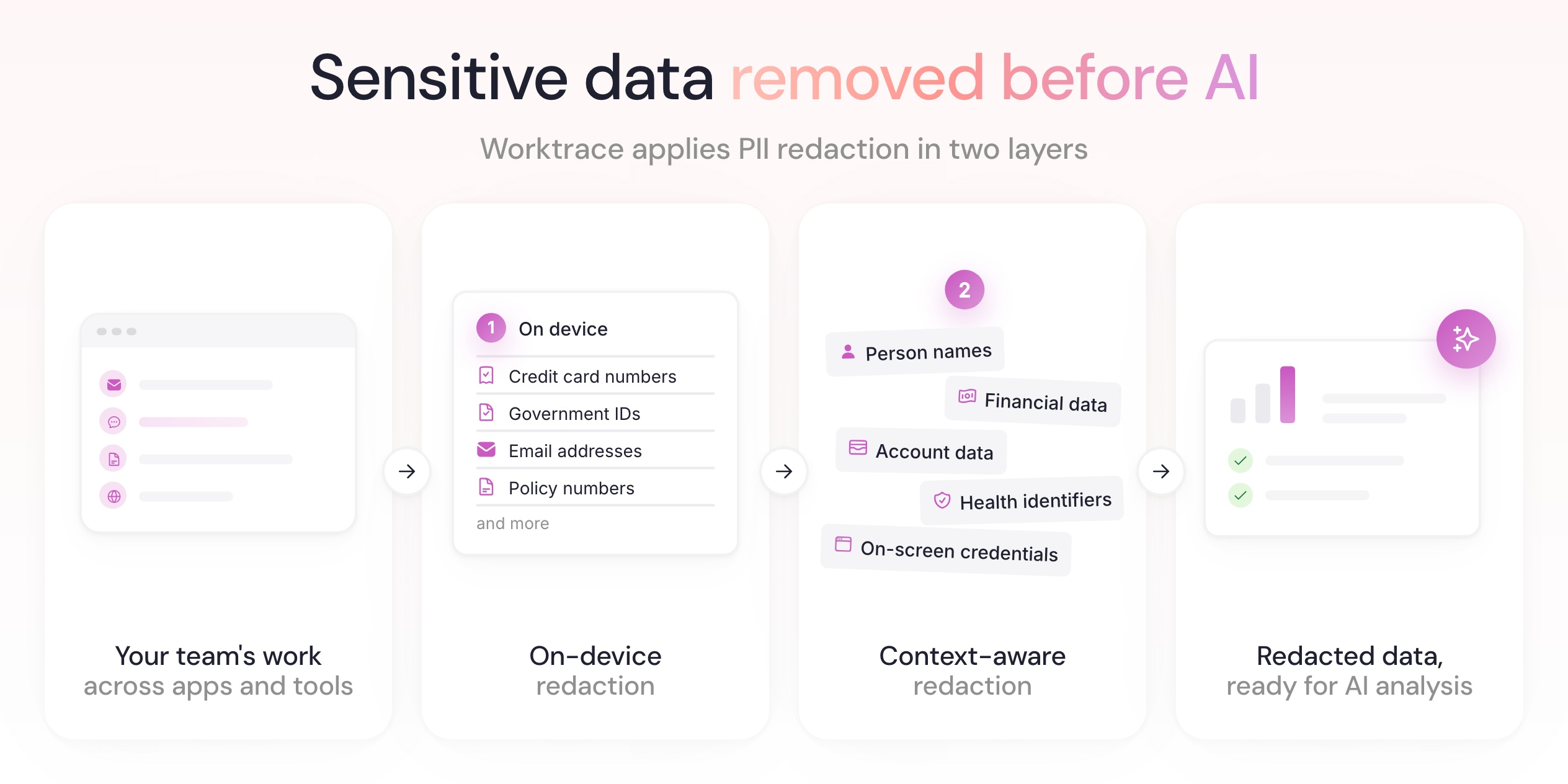
Together, the two layers allow structured PII to be removed at the source while adding context-aware PII detection before the data reaches AI processing.
{{demo}}
Controls limit what gets captured in the first place
Redaction is only one part of controlling sensitive data. Worktrace also gives teams control over what enters the workflow discovery pipeline in the first place:
- Allowlist and denylist controls: IT teams can restrict which applications Worktrace captures.
- Team-level aggregation: Workflow data is analyzed at the team level rather than used for individual tracking.
- A two-week snapshot window: Worktrace captures a defined period of work rather than continuously monitoring employees.
For organizations with stricter data requirements, Worktrace also offers on-premise and private-cloud deployment options. Worktrace maintains alignment with SOC 2, GDPR, HIPAA, and ISO/IEC 27001:2022. You can see the full breakdown on Worktrace's security and compliance page.
{{link-banner-1}}
For an Ops Leader evaluating workflow discovery or other AI automation use cases, the important questions are where redaction happens and which types of sensitive data each layer can detect. A general claim that a platform “redacts PII” doesn't tell you whether sensitive data leaves the device first, which identifiers are covered, or whether unredacted data can reach AI processing.
See how Worktrace protects sensitive data throughout workflow discovery. Request a demo to walk through the approach with your team.



Frequently asked questions
Read more
November 18, 2026
How to measure AI ROI, and why it starts before you build
Most AI ROI calculations fail before launch. Learn how to calculate AI ROI, which costs teams miss, and why a real baseline of the work comes first.

Ready to evaluate the results?

Agents you'll actually use
Worktrace discovery maps exactly how your team works and finds the most repetitive work. Then it builds Al agents that do that work.
We'll get in touch with you shortly.



of enterprise work is automatable